On April 17, 1944, the Japanese Army launched Phase One of Operation Ichi-go. It was the most ambitious military operation they had undertaken since the beginning of the war. Initially, a division of troops struck out south from the Yellow River bend to connect the railway from Beiping (Beijing) to Hankou. Eventually, the operation would involve almost half a million men and effectively cut China in half. The primary purpose of the campaign was to establish an overland supply corridor from Korea to Japan’s possessions in Southeast Asia. American submarines and airplanes had so restricted the sea lanes that Ichi-go took precedence even over operations against the United States in the Central and Southwest Pacific. An important secondary objective was to seize airfields in East and Central China used by the 14th Air Force. Since the daring raid on Taiwan, Thanksgiving Day 1943, American airpower based in China had become a growing concern to the Empire of Japan. By launching the operation in mid-April, the Japanese used the seasonal bad weather as a screen against American airplanes. With no air support, and against a better-trained and better-equipped enemy, Chinese resistance melted away.
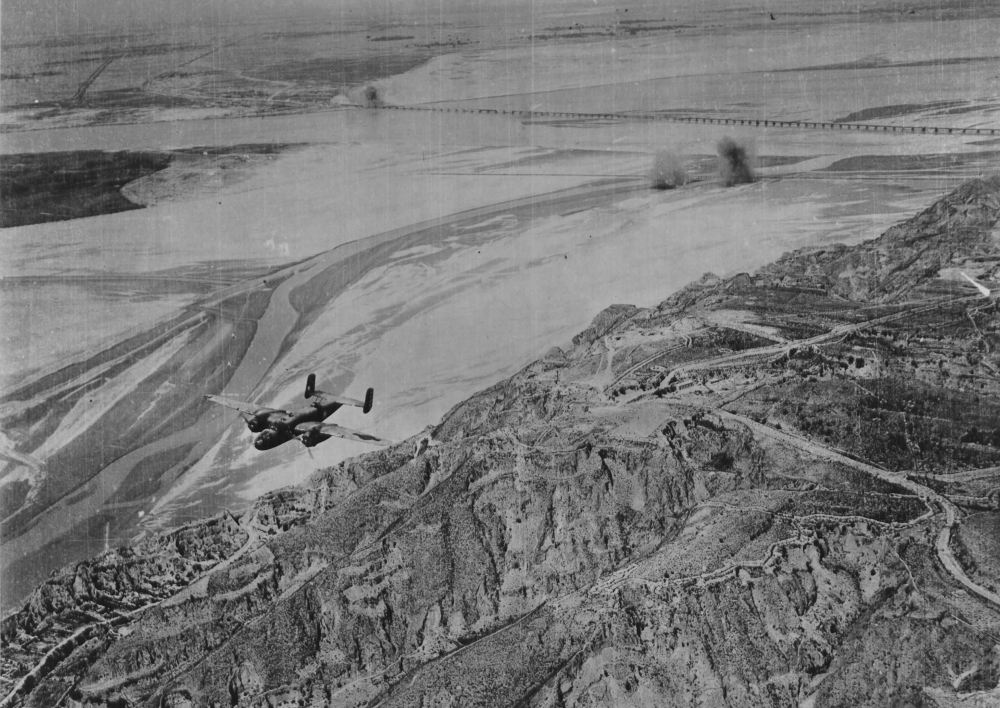
A 14th Air Force B-25 attempts to bomb the Yellow River Bridge. (National Archives)